I have several of these cards in various states. The board clearly has a minimal STD bus interface; it only uses the bus for power. That made me think that they were probably terminal boards. They are marked with LVB and one card has a ROM labelled Little Video Board.


Comparing the cards, i could see only one that was fully populated. Of the six cards, three were never completed, two were completed but have been used as spares boards. The complete card has been modified with extra connectors.
Having lots of other things to do and no doco for these cards, they sat around for several years in the “too hard” basket. While wading through a box of manuals looking for something else, i found an information sheet that shed a little light on their purpose.
The Little Video Board (LVB) is a terminal card intended for use with Pulsar Little Big Boards. The LVB emulates a Televideo 912 terminal. It operates with an ASCII keyboard and a video monitor. Communication parameters are set by the DIP switch.
The video output was obvious, so i powered the card up and had a look with the scope. The syncs were there at 50Hz/15kHz so i connected a monitor and got a blank screen with a cursor in the top left corner. This all seemed quite positive.

I traced out the video port and connected it to a Little Big Board and after messing around a little i got the TurboDOS prompt to appear on the monitor. At that point, proceedings were terminated because i don’t have an ASCII keyboard!
ASCII keyboards were apparently quite common at one time, but that seems no longer to be the case. Fortunately, a kind soul has developed and published a project that turns a PS/2 Keyboard into an ASCII keyboard:
https://www.willegal.net/appleii/appleii-kb-int.htm
Thanks Mike, for taking the time to do the design and for publishing it.
The project PCB is available from PCBway so i got 10 boards made for not much. It uses an attiny microcontroller which was easy to program with the provided hex file.
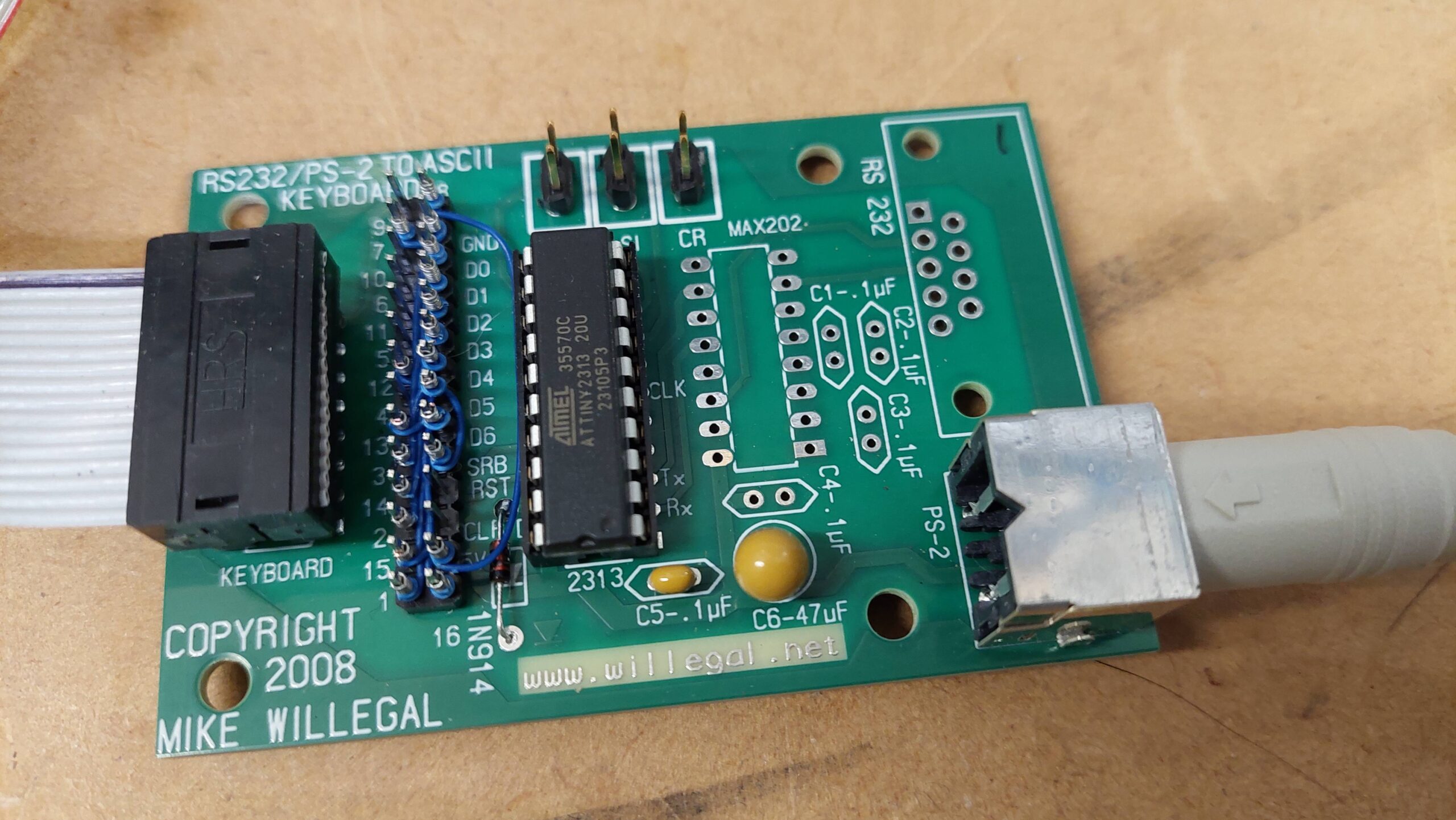
The PCB is setup to allow for any pinout. I buzzed out terminal board to find the pins that were used. The data lines were connected to the MC6821. The order of the data pins wasn’t obvious, so i took a guess and jumped up an initial configuration. Then i watched the terminal serial output on the scope to see what i got. After sorting out the bit order it was good to go. Then i replaced the jumpers with wire-wrap.
| Terminal Header Pin | 6821 Pin Function | 6821 Pin Number | Adapter DIP Pin | Pin Function |
| 1 | 8 | +5V | ||
| 2 | 9 | |||
| 3 | 7 | GND | ||
| 4 | 10 | GND | ||
| 5 | 6 | |||
| 6 | 11 | |||
| 7 | CB2 | 19 | 5 | |
| 8 | CB1 | 18 | 12 | STB |
| 9 | 4 | |||
| 10 | PB0 | 16 | 13 | D6 |
| 11 | PB1 | 15 | 3 | D5 |
| 12 | PB2 | 14 | 14 | D4 |
| 13 | PB3 | 13 | 2 | D3 |
| 14 | PB4 | 12 | 15 | D2 |
| 15 | PB5 | 11 | 1 | D1 |
| 16 | PB6 | 10 | 16 | D0 |
The Little Video Board is now a going concern. It can be used standalone or placed in the STD rack with the host computer. I have a few of these cards so it has been worth the time to get this going.